Thursday, January 11, 2018

Winternship: Week Two

Going into Week Two our EEG team is focused on securing the funds to get the passkey for the Discovery, completing the scheduling forms, and having all new members start and complete the NIH certification. Now that I'm stepping down as Chief Research Associate of our EEG team I selected a new member to take over the team. In searching for a top notch student with the passion, creative, and strong leadership attributes I came to find Adelajda Turku last semester.


Adel getting conformable into her new role and donning the QEEG cap.

Currently, going into her second semester this newbie along with all our new members our the future of STEMatics and I'm very pleased to be passing the torch down to them. Everyone is already saying she's an excellent choice and when I started EEG this opportunity fell into my lap only after my first semester at Bergen. Now, it's going to be our reason to look for leaders in the start of their academic career to grow and transform our EEG research to bring fresh new ideas, and future medical applications. 


 Alex being photo ready as usual!!!
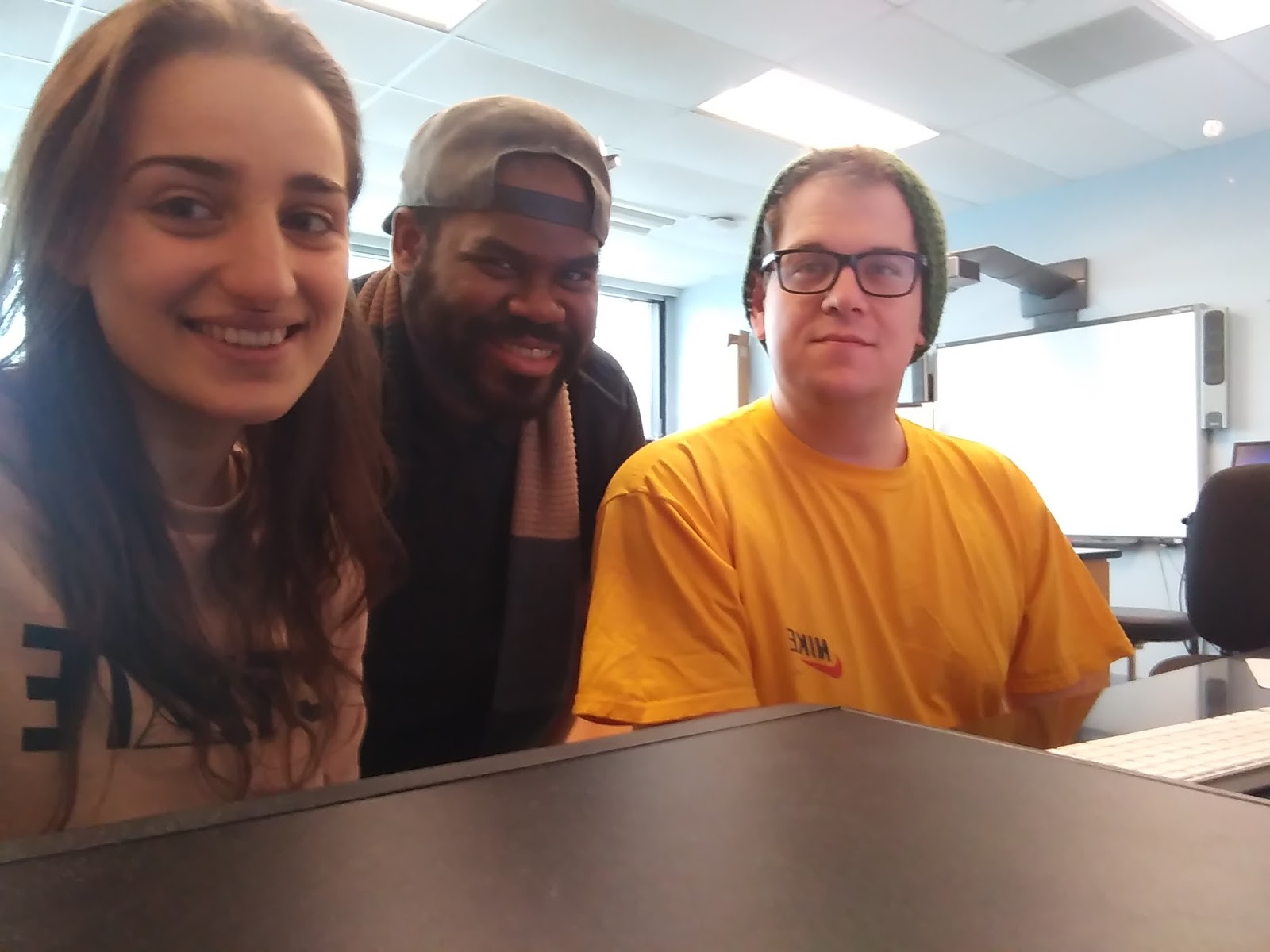

 My group, My compadres, and My friends


New Chief Research Associate Adelajda Turku and awesome right hand Alexander Czechowicz.

As far as the scheduling bits are concerned, we have the availabilities of six researchers. Unfortunately, I forgot to get the names of five of them, so at one of our general meetings in the semester, we will have to get people to identify their own schedules. We will have people ready to run ISF each day of the week save Thursday. (I suppose Thursday is a busy day for most students. Based on parking, I'd think it would be Tuesday.) We can actually start getting subjects to sign up for times as it stands!


 Adel and Alex working hard with updating our General Meeting and Spring Semester Flyer.


 This new flyer is such a departure from the old one Nikita and I designed in the summer.

In order to conduct human subjects research, each one of our administrators must complete an NIH certification. Though the two Alexes completed this research, a new leader of our team, Adel, completed this task during the Winternship. The NIH certification provides experimenters with information about ethics and duties during human subjects research.

In our previous blog post, we mentioned that our project was donated another Discovery from a third party. This would effectively double our capacity to collect data. Well, our luck continues, as Jacqueline De Vries, our long time collaborator and source of experiential wisdom, offered to have us conduct our research at her "Crossroads" clinic. Her clinic is very homey and comfortable and even has toys with which someone's kids might play.

I said in the first blog post the following:

I want to be able to look back and say the following about the Winternship:
  • We now know how to do qEEGs
  • We have a structure for scheduling appointments in place
The second goal is very much accomplished, but the first goal still needs work. Hopefully, we can schedule a meeting with Jackie early in the semester with all of our researchers to sponge up all of Jackie's information.

Friday, January 5, 2018

Winternship: Week One

Hello, everyone. Hope you had a nice winter break. 2018 should be an interesting one.

For the EEG project, we hope to tidy up some loose ends moving into data collection for the spring semester. The Discovery, pictured below,


Is the key to our research. We obtained this hardware on loan from our colleagues at Brainmaster and we are now waiting on some paperwork to go through so that we can enter a code that will allow us to begin learning how to administer qEEGs.

The other main aspect that should be solved before next Thursday is that of scheduling. I had some ideas about coding a series of forms and spreadsheets that would auto-populate and match subjects with administrators, but my skill set doesn't really allow for that sort of thing to pop up out of thin air. Maybe during the semester someone can make my vision a reality. Until then, I am petitioning our members to see when their availability for running ISF land and then compiling a form to send out to our subjects. As I'm writing this, I'm also contemplating what would be necessary to increase our subject base. (I'm going to have to head to the office of student life soon)
(There's Dorothy. Things are quiet in the winter.)

Other news involves the possibility of a second discovery unit and a more in-depth collaboration with Jackie who is mentioned many times in prior posts.

I want to be able to look back and say the following about the Winternship:
  • We now know how to do qEEGs
  • We have a structure for scheduling appointments in place


Hopefully, at the end of next week, I can show these results. Happy New Year!!!!!!

Tuesday, July 25, 2017

Week 3

We are back to week 3 of our internship!

Let's welcome Elizabeth (Liz) to our group. She has background in Environmental Science and she is pursuing a double Associate's degree in Biology and Psychology.  


                            We are discussing the experimental design of our research study.


                                                           Trying our new selfie stick!


Thursday, July 20, 2017

Week 2

Let's welcome a new EEG project member, Hoda Farag to the team. She is excited to start her first research project. Her plan is to transfer to Rutgers University and eventually become a Physician Assistant.


                                                                    New group selfie!


Alex Thomas and Nikita Sharma showing Hoda how to implement the  Infraslow Fluctuation Training (ISF). She learned how to apply electrodes in different hemispheres of the brain and identify the symptomatology and the frequency that corresponds with being too high or too low. The standard electron placement that we use is T3 and T4, which has placements and behavior such as: Migrane, Asthma, Cognitive distortions, and Severe mood swings.Compared to T4 and P4, which is used for people with PTSD and Anxiety.


Applying the electrodes to Alex Thomas 


In between Alex's training 


The training is finally completed


Wednesday, July 19, 2017

Welcome to Summer II EEG Internship- Week 1

Hi everyone,  I would like to welcome you back to our blog. I hope you had a great July 4th weekend!

Moving forward, we distributed individual jobs within our team members. Alex Thomas met with Stem President, Maryam to reach out to the STEM union members who are interested to become a participant. Alex Czechowicz and Sibora Peca coordinated the current team members schedule for the Fall semester and helped to compile subjects better. Nikita Sharma created calendar to organize the participants availability for the training and send out emails to sign up.

Today, Alex Czechowicz and I are doing the training to get the better understanding when we are working with future participants.


Trainer Alex Czechowicz and I


This is Alex Czechowicz learning to apply the electrodes


During the training, I had symptoms of earache which extended to the jaw in the right side of the brain. We found analysis possibly relating to the article the team read.


Sibora reviewing the email


Email is ready to be sent out!


Thursday, June 29, 2017

Week Six: Major Goal Setting

It just got real.


:)

No pictures this time.

Summer I's end brings a need for coordination, new research, and expanding horizons with regards to our ability to make quantitative conclusions about our research.We have to begin work on organizing our participants and our subjects, and that means a lot of administrative work and face to face time. 

A new mission of ours is to be able to have a computer program predict the existence of anxiety in subjects.

For the next two ish weeks, it's reflection and barbecues.

See ya then!

Thursday, June 22, 2017

Week Five: Trainings

Hello!!!!!

We secured the Atlantis last week but the prongs on our cord were bent.


After getting a new cord, we began learning how to administer the training.


The training plays audible pitches while feeding back from brainwaves that are in the 0-.01 Hz range. The following is our Raspberry Pi station.


We are going to write our data directly to this thing. The following are pictures of our messy new room and me trying to figure out the BrainAvatar software.


Ooh. Coding...


The next step is taking people's baseline qEEG readings so that we can begin administering the training and observing its effect.