Wednesday, January 8, 2020

January 8th- Erika Marshyti
Having all of the consent forms updated and looked over by our mentor, professor DiLauro, we continued with the research on sugar. We started setting up our literature review document.
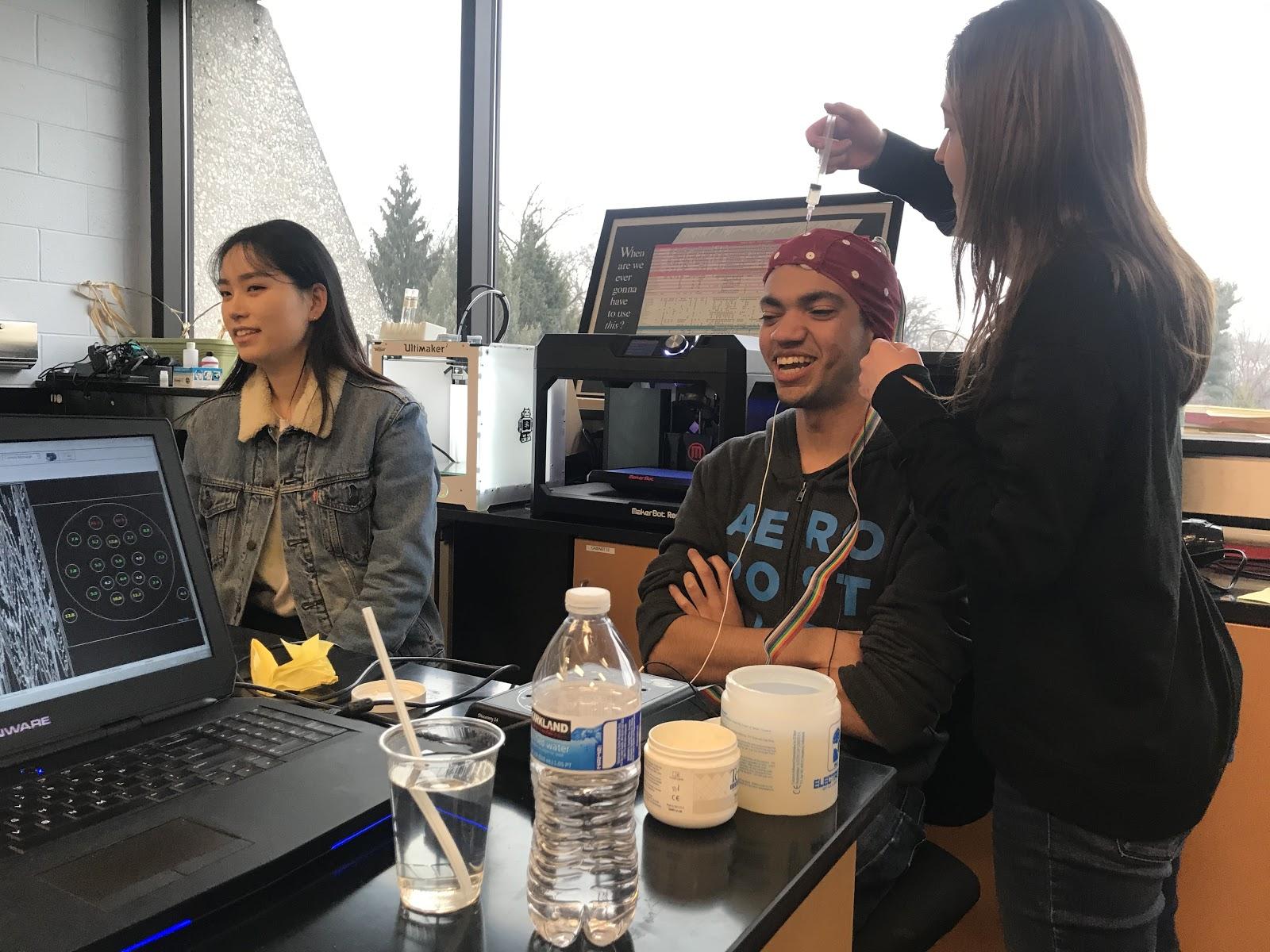
(Performing the experiment with a Doughnut on our volunteer Leyki/ picture portrays the use of electro gel while filling the EEG Red cap till the dots on the screen turn from red to green, accentuating the right amount of gel in the designated area).

In addition to this, we laid out the timeline of the next week to collect data from participants. We managed to enroll up to 16 participants to meet the goal of 60 participants in total.
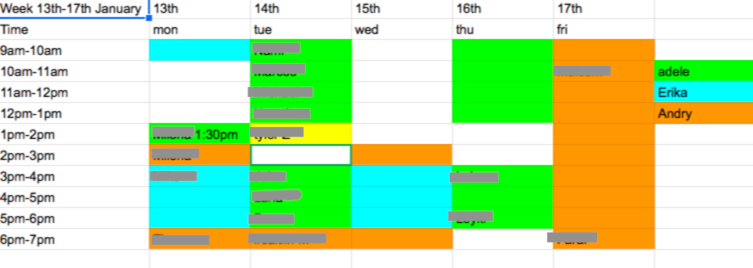
(Screenshot taken by Erika)

We also discussed to set our future goals for January and the coming months:
Collect at least 60 participants t total
  • Analyze all data with S.A.R.A software
  • Complete the literature review while writing the research report

January 9th- Erika Marshyti 
Today, as the last day of the internship, in the morning hours we continued researching more about how high sugar intake can affect the brain waves. After reading new information, we gathered everything in an organized manner, and we saved everything for future reference. Later on, during the day, we concluded the PowerPoint that we were going to present on the final presentations at 2:30 PM. Later, we shared our parts and we started practicing. Once all of the presentations were over, we headed back to the old STEM room, we collected all of our equipment, and we put everything in our designated cabinet.


January 6th- Andry Lupuche
After several hours of literature research, we found interesting research on sugar. According to the article “Sugar addiction: Is it real? A narrative review” from the British Journal of Sports Medicine, August 2017, sugar is equal or even more addictive than heroin and cocaine due to its white crystalline form, which behaves like a chemical or drug. Also, when the brain is low in dopamine (brain neurotransmitter and hormone), this leads to withdrawals following for a perpetual sugar intake which leads to addictive behavior. Another important point to mention is that according to applied studies in both animals and humans there are substantial parallels and overlap between drug abuse and sugar, from the standpoint of brain neurochemistry as well as behavior. Because of these findings, the team believes that a deeper knowledge of the fundamentals of addiction will allow people to make informed decisions in their own lives, to adopt healthy lifestyles to reduce the abuse of refined sugars in their diets and to support scientific research that improves the well-being of the community.


 (Visual map created by Andry Lupuche)

In addition to this, the team refined the details of the experimental procedure, which consists of the following steps: 
1. Set up the equipment on the old Stem room bench (brain master machine, syringes, special gel, donuts, and juice).
2. Have the participants close their eyes for the entire length of the experiment, to limit the artifacts collected from the device.
3. Keep a safe and pacific environment in the room.
4. Give instructions to the participants when the food was going to be administrated to them, and how to sip from the juice cup.

January 7th - Andry Lobuche
We managed to record data from three participants! However, the data recorded presented a lot of errors due to the artifacts like movements when chewing and sipping. Because of this, we decided to save the data anyways and discussed the new experimental design. It is illustrated in the following image.

(Visual map created by Andry Lupuche, Images obtained from google images)

Description of the experimental design:
  • Before eating: the participant will be watching a slideshow of images of food with high content of sugar while data will be collected.
  • Eating the doughnut with cookie (to exceed the content of the suggested amount per day): no data will be collected.
  • After eating: the participant will watch the same slideshow of pictures while brain wave activity will be recorded.

From this well thought design, we will be able to take a video of the activity of our brain frequencies and the brain pattern before and after eating food rich in sugar. We expect to see frequencies and patterns that are like the ones for opioid addiction and alcoholics.


Electroencephalogram (EEG) Project


TEAM: 
Adelajda Turku- aturku@me.bergen.edu
Andry S. Lupuche Rodriguez- andrysofia_10@outlook.es
Erika Marshyti- emarshyti118686@me.bergen.edu


MENTOR:
Dr. Coleen Dilauro- cdilauro@bergen.edu


BLOG:


January 2nd- Adelajda Turku
The first day, along with our mentor Dr. Dilauro, we decided to focus on the EEG project to study the effects of sugar on brain-wave activity patterns. After that, we set the following goals for the project:
Day 1
  • Discuss the experimental design to show the effect of sugar in the brainwave activity pattern
  • Explore the literature review on similar studies conducted with sugar 
  • Update the consent form for participants
Day 2
  • Test for equipment functionality and run a test case
  • Have access to S.A.R.A software to analyze data (email the Netherlands at the headquarters)
Day 3/ Day 4
  • Research literature review on addiction 
  • Finalize experimental design
  • Enroll participants and collect data
Day 5/ Day 6
  • Enroll more participants to collect data
  • Set future goals

In addition to that, we discussed the possible experimental design to conduct the study. We researched the food with the highest content of sugar and that could be purchased in the vicinity of the campus. Based on the research conducted, we agreed that Boston cream doughnut with a fruit juice was the perfect option and could have been purchased at the cafeteria of the campus at Dunkin Donut. In fact, this exceeded the limit of 27g of sugar per day. Additionally, we researched the ingredients in the main website of Dunkin Donut to include them in the Consent form for any food allergy. We updated the Consent form to the following one:

STEM Student Union
Psychophysiology and Neurophysiology Experimentation and Research

            Research Director                                           
Dr. Coleen C. Di Lauro                                   
cdilauro@bergen.edu                                     
(201) 926-9000                                               

Consent Form 

The purpose of this study is to allow participants to learn about the human brain and nervous system.  Participants will learn to use test equipment and perform laboratory exercises to monitor the nervous system. In addition, participants will learn to develop their own devices with which the nervous system interacts. 

You are invited to participate in this study on a voluntary basis by signing up for and satisfactorily completing training for use of each piece of test equipment and implementation of laboratory techniques therein.  All training shall be conducted by a Research Director.

 Some equipment and laboratory exercises involve attaching multiple electrodes directly to your body at various locations on your head and/or on your skin at locations of key muscles using an adhesive meant for that purpose.  In addition, a conductive gel may be applied between the electrode and your skin. This gel may feel cold. Also, to hold the electrodes in place on your head, a head cap holding multiple electrodes might be worn. The head cap covers the top of the head and wraps tightly around the chin so as to be held securely in place.  In some instances, in the course of implementing laboratory exercises, electrodes or a head cap may be worn for more than an hour. 

The instrument utilized is the Electroencephalogram (EEG) Brain Master Technology Discovery, which is a non-invasive tool to collect data on brain activity. The project aims to study the effects of sugar on the human brain. For this, doughnuts from Dunkin Donut and juice from the cafeteria will be purchased and available to the participants for the course of the study. The ingredient of the purchased doughnuts and juice is available to check for food allergies. 

During each experiment that involves data collection, data pertaining to you will be stored on the Alienware laptop accessible only with a secured password. Your information on the Alienware laptop will be encoded with an alpha-numerical identification system. This practice ensures privacy. The Alienware laptop will be secure in the STEM Center and accessible only upon request to the faculty mentor Dr. Coleen DiLauro.

You will receive no additional compensation for participation in this study other than compensation you might normally be receiving as part of an ongoing internship.

If you feel that you have been injured as a result of participating in the demonstration, notify the person administering the test immediately. The person administering the test must escort any injured participant to Public Safety, document the incident and injury, and as soon as circumstances permit, notify a Research Director. 

Your signature on this form means that you understand the information presented and that you want to participate in the study.  You understand that participation is voluntary and you may withdraw from the study at any time. Your signature is an acknowledgment that you do not have any physical or mental condition that may be aggravated by participation in this study or that if an exacerbation of such a condition occurs, you would cease participation indefinitely.  You also acknowledge that you are over 18 years of age. 

Ingredients of doughnut retrieved from:  


Hereby I have read the ingredients’ list and I certify I have no known food allergies on these. 


________________________________                    _______________________________
Signature of Participant                                              Printed Name of Participant

January 3rd- Adelajda Turku
The second day of the winter internship was more practical: in the morning we discussed the project idea with Dr. Dilauro showing her the Consent Form for approval. Later during the day, we checked the equipment and run a test trial. The RedCap and the Brain Master Technology Discovery, the instruments utilized to record brain wave activity, showed some issues. The RedCap was properly worn. However, the Brain Master Technology platform on the computer screen was not recording information on the two frontal electrodes. After cleaning the RedCap carefully and putting more gel on the electrodes, we managed to fix only one electrode. Since the other electrode is not recording information, we will eliminate this error with the S.A.R.A software which erases all artifacts. We discussed with Dr. Dilauro to take care of this inconvenience and contact assistance.

(Picture taken by Andry/ Adele volunteering for the test trail to check the equipment)


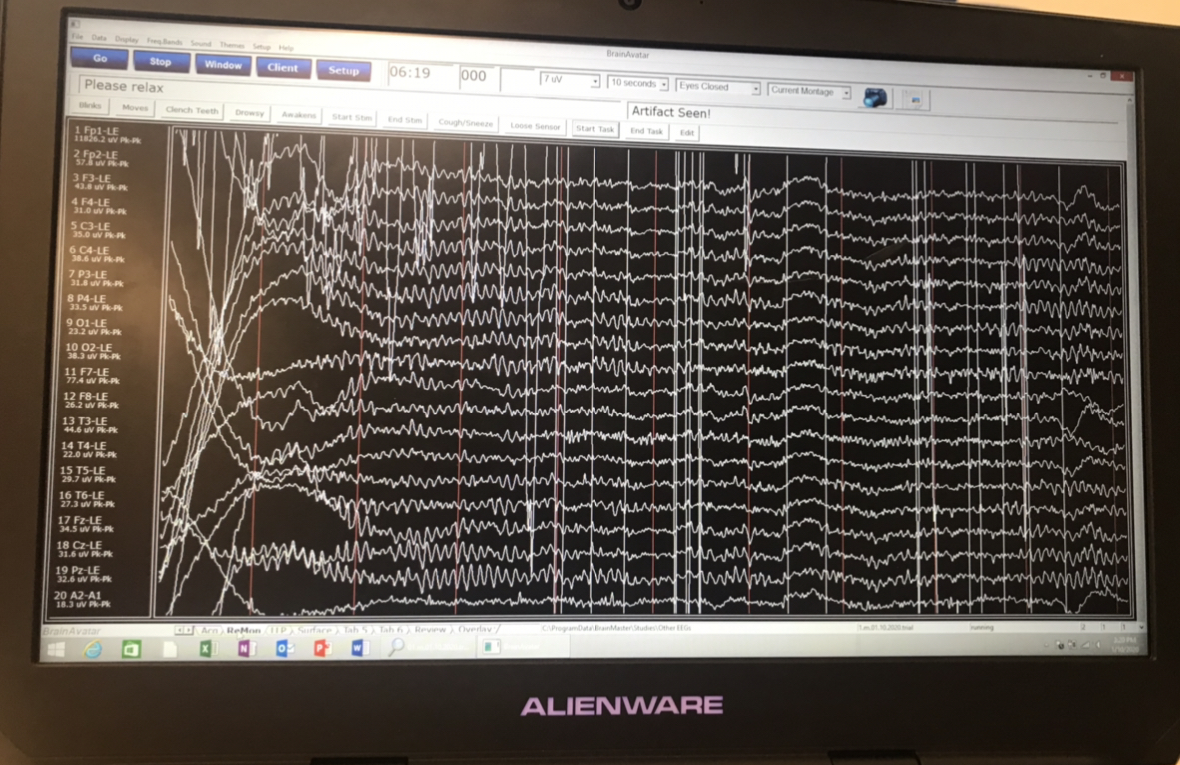
(Picture taken by Adelajda/ Sample of brainwave-activity pattern recorded during the session)


After recording and saving the data, we logged into S.A.R.A. software to clear all the artifacts. We were not able to proceed because of the contract expiration. We contacted the headquarters in the Netherlands after discussing with Dr. Dilauro on the plan of action on this setback.

Sunday, October 28, 2018


Hi all, Adel speaking

The 27thof October, the EEG Team had the chance to present its project at the 51th MACUB Conference in Queensborough Community College along with around 140 projects from New York, New Jersey and Maryland States.  

I was very excited as it was my first time presenting at a conference out of Bergen, and super excited to show our work to a different else.
After an inspiring talk on the arts and neurons of the PhD artist Gregory Dunn, the time to present our poster to the judges followed right away. Students, teachers and amateurs from other colleges and universities were listening to what the EEG Team had been doing until that moment. Neurofeedback was changing someone’s life. Sound at a very slow frequency, was rearranging the brain neural network for a calm and relaxed state.

However, what the interlocutors could not see in the poster was the focused work of a team who experienced different challenges. One of which has been preparing the paper works to have access to the equipment, which had slowed the research’s progress tremendously.
Regardless that, we still made it to present to the Stem C^2 at Bergen in April, the STEM Summit in August still in the house and eventually at the MACUB Conference where we got assigned first place for poster presentation in the Community College category.

I felt humbled when I was handed the Certificate of Achievement at the award ceremony.
In actuality, that certificate is crowing the dedicated work of Dr. Dilauro, the effort of the team for progress and the committed participation of the veterans to the study.

Big thank you to the veterans for giving their time to the STEM Union, sharing their stories and inspiring us to give our best. Huge appreciation hug to all the members who decided to lose themselves in the study of the brain scans and later analyze the indecipherable data for the sake of the learning process: I was honored to represent you all to that conference. Most importantly, a great aknowledgement goes to the work of our mentor Dr. Dilauro for putting our project first, her patience in every explanation and her will to help out of the ordinary.
The MACUB Conference symbolizes the beginning of journey. 

P.S. A message to future members: believe in the transformative impact of the project.

Monday, July 30, 2018

STEM summer internship 2018 (6/23 ~ 6/26)

July 26, 2018

This week, we began utilizing the Discovery 24 to scan EEGs from new subjects and continued employing the Atlantis II to conduct ISF on returning subjects.  A large portion of our subjects consist of war veterans, since ISF has shown to mitigate the symptoms of PTSD.b


EEG Brain Study team serving our veterans!


On Thursday, we presented the basis of our project and our current findings to other BCC students and professors. We could present our vision, mission, values, and goals to other students and mentors. 

Presenting our project to our peers

Monday, July 9, 2018

STEM Summer Internship of 2018 (7/2-7/5)

STEM Summer Internship of 2018 (7/2-7/5)


As summer 2 started we set our goals for the semester: perform extensive ISF trainings.
The semester started with good news: we received the passkey for the Atlantis 2 and had access to the program on our server.

In this post we are going to share the procedure to perform an ISF training

After our volunteering participants compiled a consent form for the training and a consent form for publishing their pictures on our website, we conducted a little survey.
Based on the survey, we were able to determine the site to place the electrodes: for our participants were T3 and T4 (respectively, temporal lobe on the left and temporal lobe on the right side)


Adelajda and the electrodes placed on her head.
To glue the electrodes, we applied two kind of gels: the "NuPrep" cream to apply to the skin to clean it and the  "Ten 20 Conductive" to use for the electrodes to facilitate the connection with the skin.


Hynbin decided to be our participant the first week of her internship.
As we can see from the pictures, the electrodes have different color and we had to place them in the right positions. 

The Ch1 is connected to the left lobe: 
- A1 is connected to the red electrode that should be placed on T3, temporal lobe, left side (an inch above the left ear)
-R1 is connected to the yellow electrode that should be placed on the Mastoid, the left side
Ch2 is associated to the right side of the lobe:
-A2 is connected to the black electrode to be placed on T4, temporal lobe, right side (an inch above the right side of the ear)
-R2 is connected to the white electrode to be placed on the Mastoid, the right side
G indeed is connected to the green electrode to be placed on the forehead.


During the first ISF training, we had to find the optimal brain frequency, the one at which the parasympathetic nervous system (also known as the rest and digest activation) is stimulated. The starting frequency is very low(0.0030 Hz) and is gradually increased until the participant feels relaxed.


The picture shows the During-Session Notes allowing us to keep track of the frequency, and the feelings of our participants on a regular interval of 5 minutes.
The duration of the session extends to 30 minutes